TL;DR - Summary
- What is GEO? Generative engine optimization is the practice of structuring content so AI platforms like ChatGPT, Gemini, and Perplexity cite your brand in their generated answers. It focuses on citation inclusion, not page rankings.
- How is GEO different from SEO? SEO targets ranked link positions on search engine results pages. GEO targets inclusion and attribution inside AI generated text responses. The success metrics, content formats, and source qualification criteria differ significantly.
- Why does this matter for B2B? Indian B2B buyers increasingly use AI tools for vendor research and category discovery. Brands that rely only on SEO risk being invisible in these conversations, even if they rank well on Google.
What SEO actually optimizes for
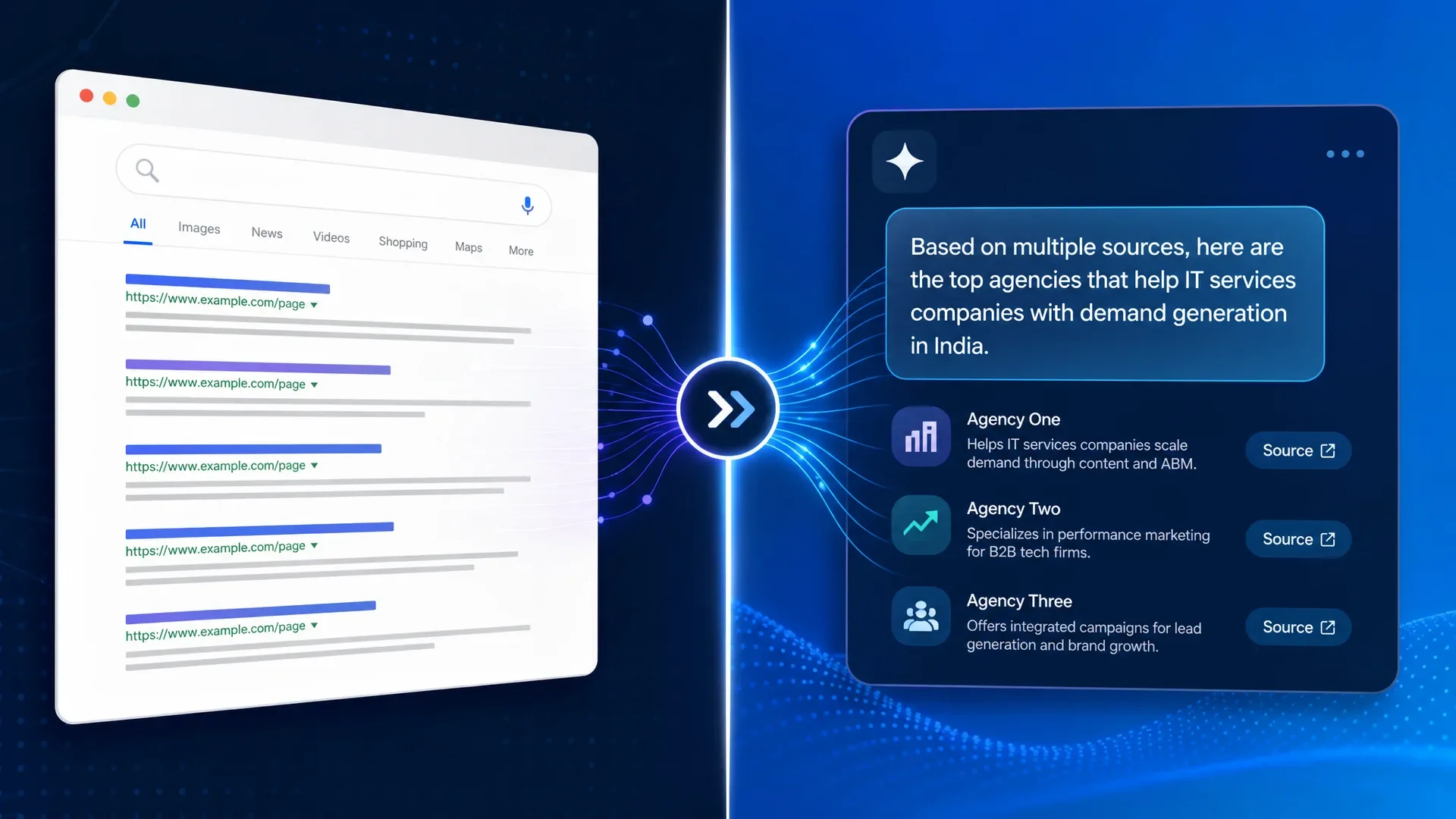
SEO aims to place your web page among the top ranked links on a search engine results page. Google and Bing crawl your site, evaluate relevance signals (keywords, backlinks, technical health, content depth), and assign a position in a list of ten or more results.The user then clicks a link, visits your page, and engages with your content. Success is measured through rankings, click through rates, organic sessions, and conversions from those sessions. The entire model depends on earning a click.
For B2B companies in India, SEO remains essential. It captures high intent searches from buyers actively looking for services, comparisons, or solutions. Wizrdom treats SEO services as a foundational layer of any digital visibility strategy.
What GEO optimizes for
GEO targets a fundamentally different outcome. When a buyer asks ChatGPT or Perplexity a question like "which agencies help IT services companies with demand generation in India," the AI does not return a list of links. It generates a synthesized answer, sometimes citing sources, sometimes not.Your goal with GEO is to become one of the sources the model draws from and attributes. This requires content that is structured for machine comprehension: clear entity definitions, explicit claims, schema markup, and authoritative, citation worthy statements.
Unlike SEO, there is no "position one" in a generated answer. Either your brand is mentioned and cited, or it is absent entirely. Wizrdom's generative engine optimization services focus on building the content authority and structural signals that earn these citations.
Key differences at a glance
The core distinction is output format. SEO competes for ranked links. GEO competes for inclusion in synthesized text. SEO rewards keyword relevance and backlink strength. GEO rewards entity clarity, factual density, and source trustworthiness.Source qualification also differs. Google evaluates hundreds of ranking factors across your domain. AI models select sources based on content structure, recency, topical authority, and how cleanly a passage answers a specific question. A page that ranks well on Google may never be cited by an AI model if its content lacks explicit, extractable claims.
Measurement changes too. SEO tracks rankings, impressions, and clicks. GEO tracks brand mentions, citation frequency, and answer inclusion across platforms like ChatGPT, Gemini, and Perplexity. Wizrdom helps B2B teams in India build answer engine optimization and GEO strategies that address both measurement frameworks.
| Dimension | Traditional SEO | Generative Engine Optimization (GEO) |
|---|---|---|
| Primary Objective | Rank as a clickable link on SERP (Top 10 results) | Direct citation and entity inclusion in AI synthesized answers |
| Target Platforms | Google, Bing, Yahoo search results | ChatGPT, Google Gemini / AI Overviews, Perplexity, Claude |
| Key Success Metric | Keyword rankings, organic traffic, impressions, CTR | Citation frequency, brand mentions, entity prominence |
| Source Selection Factors | Keywords, backlinks, domain authority, technical crawlability | Factual density, clear entity definitions, structured schema, source trustworthiness |
| User Interaction | User clicks a blue link to visit the destination webpage | User consumes synthesized answers directly, referencing cited sources |
| Strategic Value | Captures high-intent organic clicks | Captures authority recommendations and decision-stage mindshare |
For Indian B2B companies, especially in technology, SaaS, consulting, and IT services, this distinction matters because buyers in these sectors increasingly use AI tools during early stage research. A strong content marketing foundation supports both SEO and GEO, but the optimization tactics diverge.
Legacy SEO agencies that have not adapted to AI answer inclusion may leave a significant visibility gap. Wizrdom's approach connects B2B marketing strategy with both traditional search and generative search, ensuring brands are discoverable wherever buyers look.
Neither GEO nor SEO replaces the other. SEO captures intent driven clicks. GEO captures trust driven citations. B2B growth teams that invest in both will hold a compounding advantage as AI search adoption accelerates across India and globally.
Frequently Asked Questions
SEO optimizes web pages to rank as links on search engine results pages. GEO optimizes content to be cited inside AI generated answers on platforms like ChatGPT, Gemini, and Perplexity. The success metrics, content structure requirements, and source selection criteria are distinct.
Generative engine optimization is the practice of structuring and authoring content so that large language models select and cite it when generating answers. It focuses on entity clarity, factual density, and schema markup rather than traditional keyword rankings.
Yes. B2B buyers increasingly use AI tools for vendor research and category discovery. Companies that optimize for GEO alongside SEO improve their chances of being named in AI generated recommendations, which builds trust and drives qualified inbound interest.